

What is Parmigiano
Reggiano PDO?
Characteristics, PDO regulations, map of the five provinces
and aging stages: the complete guide to the king of Italian cheeses.
What is Parmigiano
Reggiano?
Parmigiano Reggiano PDO is a hard, cooked-curd cheese produced exclusively from raw cow's milk, natural rennet and salt. No additives, no preservatives: just milk, time and artisan knowledge.
Each wheel weighs between 38 and 45 kg and requires approximately 550 litres of milk. The PDO regulations impose strict standards: production limited to five provinces in Emilia-Romagna, cows fed on local forages, artisan processing within 24 hours of milking, and a minimum ageing of 12 months.
of Origin — EU 1996
A defined zone.
A guaranteed origin.
Only cheese produced in these five provinces, under the rules of the Production Specification, may bear the Parmigiano Reggiano PDO mark.
- Parma — from the Food Valley to the Apennine hills
- Reggio Emilia — cradle of the first Benedictine abbeys
- Modena — fertile plain, thousand-year dairy tradition
- Bologna — only west of the Reno stream
- Mantova — only south of the Po river
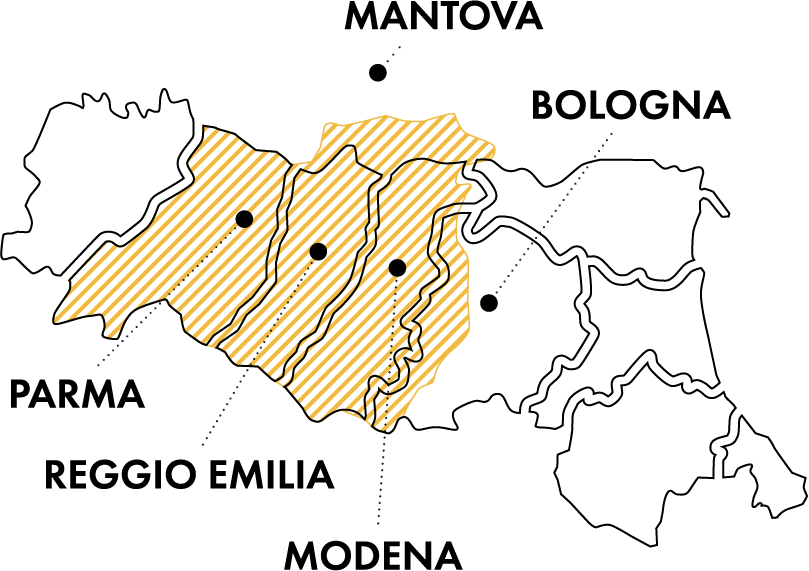
Bologna only west of the Reno · Mantova only south of the Po
More Than
Just a Cheese
Parmigiano Reggiano is much more than a food product. It is the result of a territory, a precise method and a tradition handed down through the centuries.
By law, only cheese produced according to a rigorous specification — which governs every stage from the milk to the ageing — may be called Parmigiano Reggiano. Everything else is imitation.
Where It
Truly Comes From
The real Parmigiano Reggiano is born only here: in the provinces of Parma, Reggio Emilia, Modena and in limited areas of Bologna and Mantova, where the bond between land, farming and cheesemaking is an integral part of the product itself.
This unique balance makes it impossible to replicate elsewhere in the same way. Visiting a dairy means seeing this bond with your own eyes.
Only Essential
Ingredients
Parmigiano Reggiano is made with just three ingredients:
- raw cow's milk
- animal rennet from calf
- salt
No preservatives, no additives, no industrial processing. An apparent simplicity that demands absolute control at every stage.
Still an Artisan
Process
Every day, at dairies like Ferrarini & Bonetti, the milk is processed fresh, without interruption. The transformation takes place:
- in copper vats
- with natural whey starter
- through manual gestures handed down over time
This is not industrial production: it is a process guided by the cheesemaker's experience. And this is exactly what you can see in person by visiting the dairy.
Time Makes
the Difference
Parmigiano Reggiano is not made in a few days. The minimum ageing is 12 months, but many wheels mature for 24, 36 months or more, developing increasingly complex aromas.
During this time: the structure becomes granular, the flavour intensifies, the characteristics that make it unique emerge. Time is not a step: it is an ingredient.
A Real
Certification
Every wheel is checked individually. Only those that meet all requirements receive the Parmigiano Reggiano fire brand — a guarantee of authenticity and quality.
It is this brand that distinguishes the real product from any imitation. Without it, it is not Parmigiano Reggiano.
An Experience to Live,
Not Just to Read About
Truly understanding what Parmigiano Reggiano is means seeing it come to life. Entering a dairy, watching the cheesemaker at work, breathing in the ageing warehouse: these are experiences no description can replace.
At Caseificio Ferrarini & Bonetti you can experience this process up close.
Reggiano
History, key figures and identity of the king of Italian cheeses.
DiscoverReggiano
PDO characteristics, specification, provinces and nutritional values.
You are hereFrom raw milk to wheel: 24 hours of artisan craft in the copper vat.
Discover18, 30, 40 months: time transforms the cheese into a masterpiece.
DiscoverSight, smell, taste and touch: the sensory profile for each aging stage.
Discover